ACSAC 2026Forthcoming
TRACER
An agent that learns to spot cyberattacks it has never seen, even when nobody tells it whether it is right.
The problem
An intrusion detection system (IDS) watches a network's traffic and raises an alert when something looks like an attack. Modern IDS rely heavily on Machine and Deep Learning algorithms: they are shown examples of normal traffic and attacks, and learn to tell them apart.
This approach, called supervised, simply applies techniques that perform very well in other fields. For anomaly detection, however, it has two limitations:
- Unknown attacks. A model is good at recognising what it saw during training, much less so a new type of attack (a new class). This is called a zero-day attack.
- Traffic changes. New devices, new applications, new habits: even normal traffic evolves over time. The model's performance degrades, and it must be retrained regularly with data freshly labelled by experts. That is slow and expensive.
The idea: an agent that keeps learning
TRACER is built on reinforcement learning. Instead of learning once during training, an agent makes a decision for each network flow, receives a reward if it is right or a penalty if it is wrong, and adjusts its behaviour as it goes: it trains continuously.
- 01Network flowA connection comes in, described by its features.
- 02AgentIt observes the flow.
- 03DecisionNormal traffic, or alert?
- 04RewardPositive if the decision was right, negative otherwise.
↺ The agent adjusts its strategy, then moves on to the next flow
Everything hinges on the reward, which guides the agent's learning. Yet in most existing work, it is computed from the ground truth (the label). In a real network, that label is unknown for live traffic, all the more so for a zero-day.
A two-sided reward
TRACER picks how to reward the agent depending on what it knows about the flow.
Do we know the right answer for this flow?
Classic reward
The agent's decision is compared with the label. Confidence is maximal, since it relies on the ground truth.
Reward by vote
Three clustering algorithms give their opinion on the flow. The majority wins, and the reward is stronger when the algorithms are more certain.
The second path is the heart of our contribution. TRACER keeps in memory a sample of traffic it is sure is benign. To judge a new flow, it clusters a window of the current flow together with that sample of benign flows, in three different ways (Fuzzy C-Means, Fuzzy DBSCAN and Fuzzy HDBSCAN). Each algorithm votes:
- “normal” if the flow falls into a group made mostly of known normal traffic, and clearly belongs to that group (we will see what that means just below).
- “alert” in every other case.
These algorithms are fuzzy: they do not only say which group a flow belongs to, but how strongly it belongs (a membership degree between 0 and 1). If a point sits at the centre of a cluster, its membership degree is close to 1; if it lies on the border between two clusters, its membership degree is low. We use that degree as a confidence measure: a hesitant vote yields a small reward, a clear-cut vote a large one. The agent is therefore never heavily punished or rewarded on the basis of an uncertain opinion.
Using three algorithms rather than one is not a luxury: each sees the traffic from a different angle, and none is reliable alone on every network.
Try it yourself
Set each algorithm's opinion and the agent's decision: the reward is computed as in the paper.
Fuzzy C-Means
Vote : normal
Fuzzy DBSCAN
Vote : alert
Fuzzy HDBSCAN
Vote : alert
An algorithm votes “normal” if the group is mostly normal and the membership degree is above 0.3. Confidence is the average degree of the majority algorithms; the reward is ±(1 + confidence) / 2.
How we evaluated it
TRACER is evaluated on four reference datasets (NSL-KDD, CICIDS17, UNSW-NB15 and ToN-IoT), with exactly the same settings. Clustering does not work well in high dimensions, which is why we reduced the dimensionality with PCA, SCARF and an autoencoder, so as to work in lower-dimensional spaces. The evaluation covers two realistic scenarios:
- The zero-day attack. An entire attack family is removed from training, then made to appear later on. This is repeated for each of the 23 families. It is more demanding than many studies, where the “zero-day” is only a variant of an already known attack. TRACER learns from the labels on known traffic, and switches to the vote-based reward for unknown traffic — including the zero-day attack.
- Missing labels. Labels are progressively hidden, from 0% to 100%, to see how long the agent holds up.
Performance is measured with a detection score: it is high only if the agent recognises both the attack and normal traffic. A system that raises alerts all the time gets a poor score.
Results: facing never-seen attacks
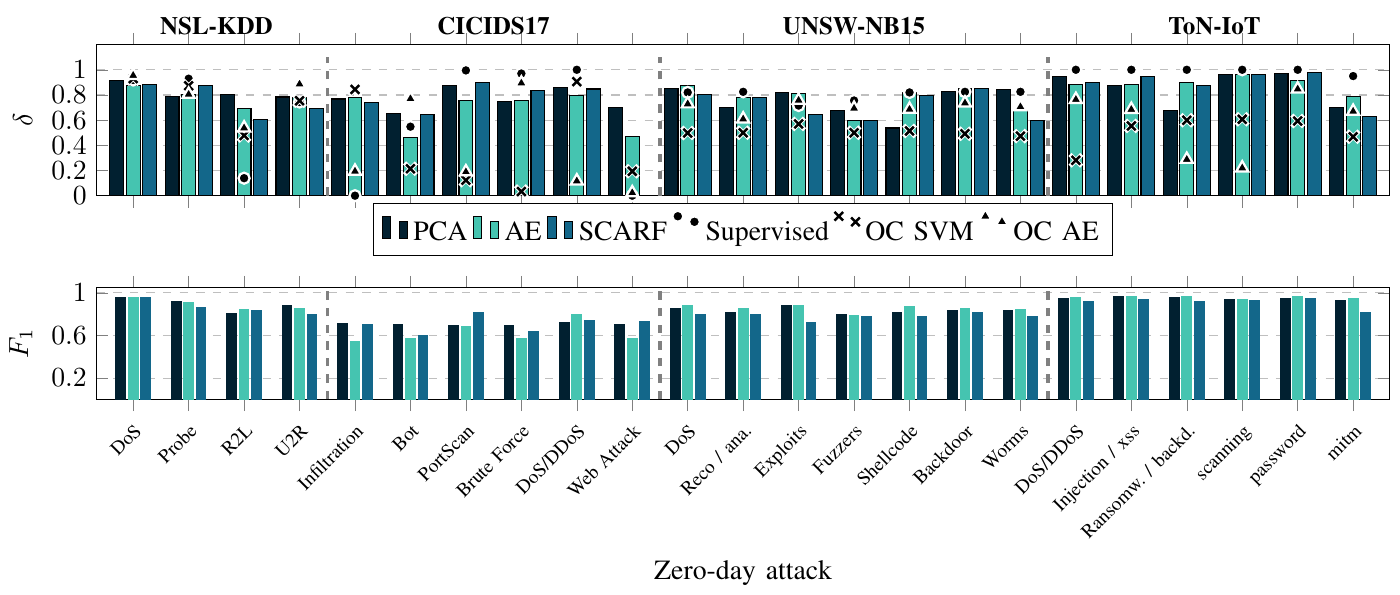
Both references are classic methods trained on normal traffic only. TRACER is used here with the PCA representation.
The detection score is often around 80% and exceeds 90% for several attack families, while staying strong on already known attacks: learning something new does not erase the old, so catastrophic forgetting is avoided.
Two results stand out:
- Rare attacks are detected. The Man-in-the-Middle attack in ToN-IoT (78.9%), Shellcode in UNSW-NB15 (81.5%) and U2R in NSL-KDD (78.5%) each account for less than 2% of the data.
- The vote-based reward sometimes beats the supervised one. On some attacks (Exploits and Backdoor in UNSW-NB15, U2R in NSL-KDD), TRACER outperforms an agent rewarded with the true labels.
Explore the results attack by attack
Recall: what share of the never-seen attack's flows does TRACER catch?
It learns fast
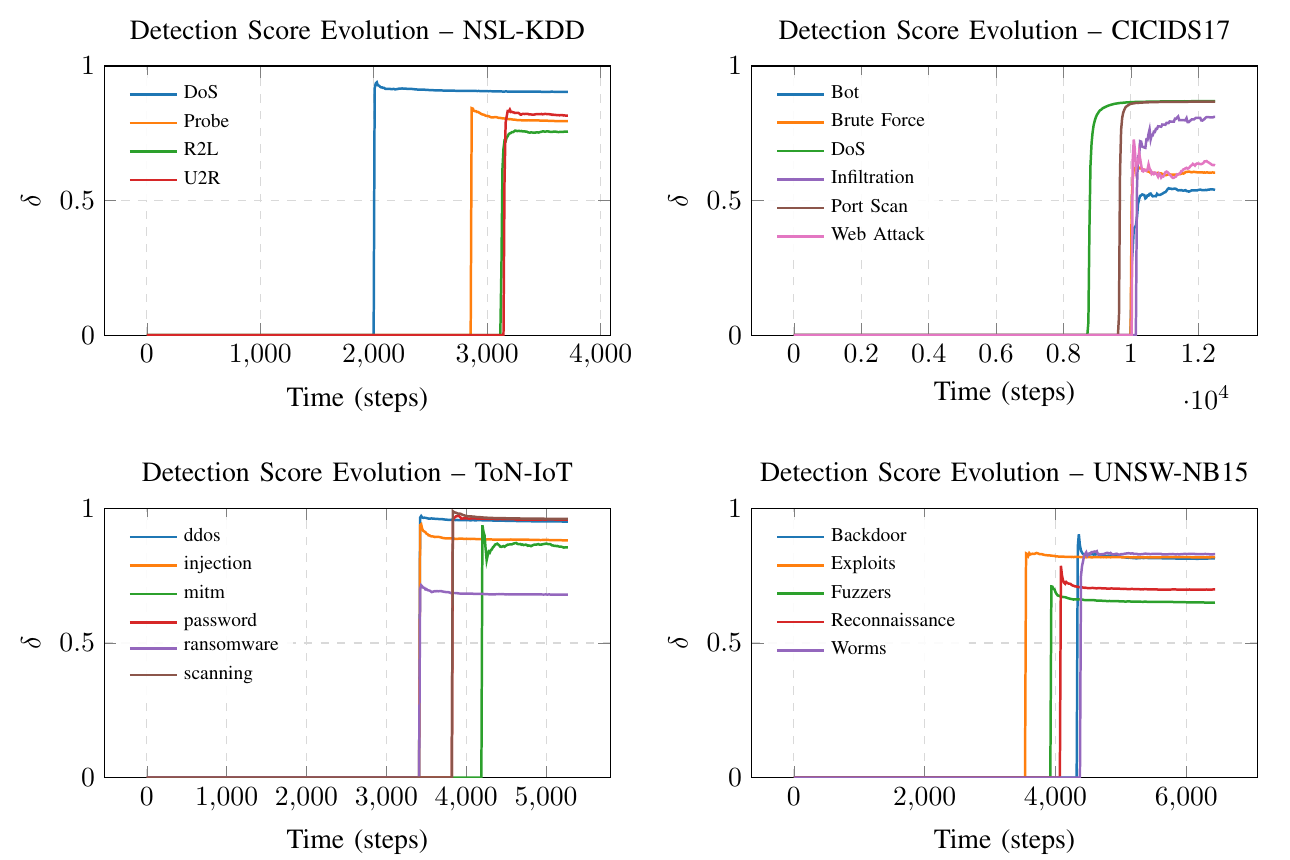
As soon as the first flows of a new attack show up, the score climbs almost vertically: for most attacks, it reaches 90% of its final value within a few dozen steps. This is essential for a zero-day, where only a handful of examples are available before one has to react.
Results: when labels are missing
Performance stays stable until about 70% of labels are hidden, then drops. In other words, a small fraction of labelled data is enough to “prime” the agent, and the vote then takes over. With only 30% of labels, the overall score stays around 80% on most datasets.
Simpler than expected
Reinforcement learning is designed for situations where each decision influences the states that follow, like a game of chess. That is not the case here: raising an alert and classifying a flow changes nothing about the next flow. The problem then boils down to a much simpler form, the contextual bandit, where only the immediate reward matters: complexity is lower and convergence faster.
The paper shows this and then verifies it: a lightweight “bandit” agent reaches performance comparable to the deep reinforcement learning agent on most attacks, with training time almost cut in half.
In the field
TRACER is designed to run close to the network, on commodity hardware. It has been deployed on an industrial partner's infrastructure, where it was measured with traffic replayed from the four datasets.
Meanwhile, a copy of the agent keeps learning in the background: replacing the live agent with its updated version takes less than 0.04 ms. CPU load stays around 23% and memory around 1.3%.
Limits and next steps
TRACER is not infallible. When an attack looks too much like normal traffic, as with Web Attack, Bot and Infiltration in CICIDS17, the clustering algorithms cannot separate it, and the agent raises too many false alerts. This is a limit for a system that only observes flow statistics, not their content.
Next steps:
- combine several data representations, since each one reveals different attacks: we are studying new latent spaces built with other dimensionality reduction techniques.
- weight the three algorithms according to the monitored network and the targeted attacks.
- study gradual traffic drift: the appearance of a zero-day is seen as a sudden concept drift, but traffic can also evolve more gradually.
- connect TRACER to real production traffic.
Key takeaways
- TRACER can keep learning without labels, thanks to our reward function based on ensemble clustering.
- This approach detects entirely new attack families, including rare ones, without degrading the detection of known attacks. Some attacks still slip through the net, however, absorbed by clusters of benign flows.
- For intrusion detection that raises alerts (IDS), the contextual bandit is enough. Deep reinforcement learning would probably be better suited when the agent can act on the network (IPS).